
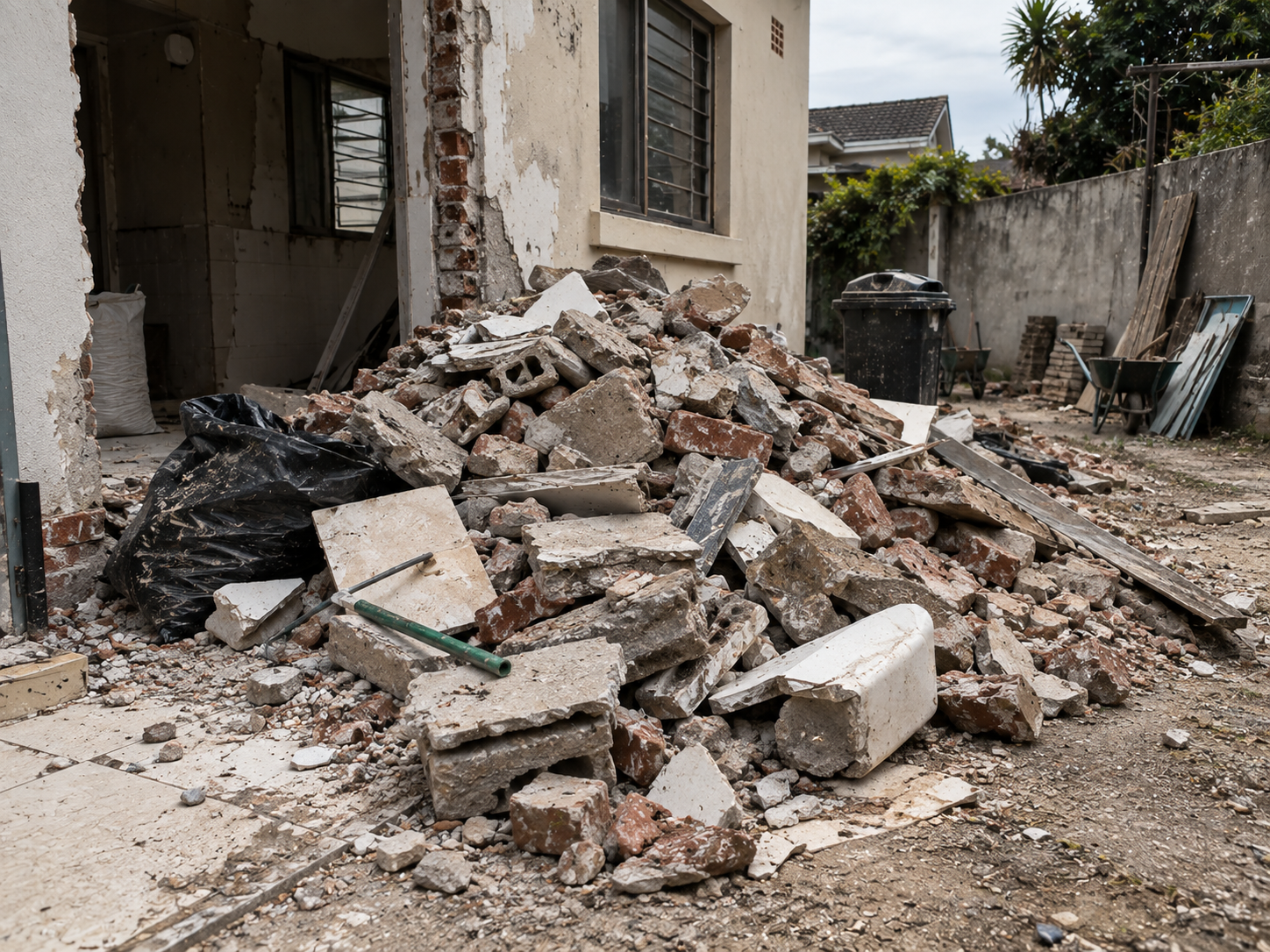
A renovation can create rubble much faster than expected. A bathroom that looked like a small project can leave piles of broken tiles, plaster, cement and old fittings behind. Removing a wall can produce several loads of bricks and concrete. Even a kitchen renovation can leave a mixture of building debris, packaging and old materials that quickly takes over the space.
The problem is that rubble removal is often treated as something to think about at the very end of the renovation. By then, the waste may already be blocking walkways, taking up parking space or making it difficult for contractors to move around the property.
Planning the removal alongside the renovation makes the whole process easier. You do not necessarily need a truck arriving every day, but you do need to think about when the rubble will build up, where it will be stored temporarily and when it needs to leave the property.
For homeowners and contractors arranging renovation rubble removal in Cape Town, the timing can make a noticeable difference to how smoothly the project runs.
Get Your Renovation Rubble Removal Planned
Arrange your rubble removal around the work being done so waste does not build up and interfere with the renovation.
Start Planning Rubble Removal Before the Renovation Begins
You do not have to wait until the first wall is demolished to think about rubble removal.
Before the renovation starts, look at the work that is going to take place and identify the stages most likely to produce large amounts of waste.
A bathroom strip-out, for example, can produce broken tiles, old screed, plaster, sanitaryware and other materials. Removing a kitchen can leave cupboards, counters, tiles and building debris. Demolition work can produce a much larger quantity of heavy rubble in a short period.
Knowing this beforehand gives you an opportunity to think about where the waste will go and when it will be collected.
This is especially useful when the property has limited outdoor space. A large rubble pile may be manageable for a day or two, but leaving it there for several weeks can become inconvenient very quickly.
The removal plan does not need to be complicated. It simply needs to match the renovation schedule.
Look at the Renovation in Stages
One of the easiest ways to plan rubble removal is to break the renovation into the stages that will produce waste.
Demolition usually comes first.
Then there may be stripping out, structural work, electrical and plumbing work, plastering, flooring, tiling, carpentry and finishing.
Not every stage produces the same amount of waste.
Demolition can create a large amount of heavy material in a short period. Tiling may produce bags of broken tiles and offcuts over several days. Packaging can accumulate throughout the project, while finishing work may produce smaller amounts of waste.
Thinking about the project this way helps you identify the points at which a collection is likely to be needed.
For a small bathroom renovation, one collection after the demolition and strip-out may be enough, followed by another collection at the end.
A larger home renovation may need several collections spread across the project.
There is no single schedule that works for every renovation. The useful part is matching the removal to the amount of waste being generated.
Don’t Wait Until the Rubble Is in the Way
There is a point where rubble stops being merely untidy and starts interfering with the renovation.
Builders need space to work. Materials need to be delivered. Tools need to move around the property. Access doors and walkways need to remain usable.
If a pile of broken bricks is sitting across the area where materials need to be carried, the waste has become part of the construction problem.
The same thing happens when rubble starts taking over a driveway that needs to be used by contractors or when waste is piled in an area needed for the next stage of the renovation.
Removing it before it reaches that point is usually much easier than trying to work around a growing pile.
This is one of the main reasons to think about builders rubble removal in Cape Town as part of the project rather than treating it as a final clean-up task.
Where Should Renovation Rubble Be Kept Before Collection?
Rubble needs somewhere to go while you are waiting for collection.
Ideally, it should be kept in a designated area where it does not interfere with the renovation.
The area should be accessible for removal, but it should also be safe for people moving around the property.
Avoid creating a pile directly in front of doors, gates or narrow walkways simply because that is where the waste was produced.
If demolition is taking place inside the house, the rubble may initially have to remain close to the work area. But once that stage is complete, moving the waste to a suitable collection point can make the rest of the renovation easier.
For larger projects, contractors may already have a system for moving waste out of the work area as the job progresses.
For smaller home renovations, the homeowner may need to decide where the temporary pile will be kept.
The important thing is to have a plan before the rubble starts accumulating.
Keep the Access Route Clear
The location of the rubble is only part of the planning.
You also need to think about the route the removal team will use to get to it.
A pile may be easy to see but difficult to reach.
For example, rubble at the back of a property may need to be carried through a narrow passage. A pile inside a garage may require the vehicle to park outside while the material is moved out. Rubble on an upper level creates a different loading situation again.
When deciding where to keep renovation waste, think about how it will eventually leave the property.
Keeping a reasonably clear route between the rubble and the vehicle access point can save time later.
It also prevents the removal team from having to work around building materials, tools and other items that have accumulated during the renovation.
Book Removal Around the Messiest Stages
You do not necessarily need to book removal after every small task.
Instead, look for the stages that are likely to create a significant amount of waste.
Demolition is an obvious example.
If a contractor is removing a wall, knocking out old flooring or stripping several rooms, waiting until the entire renovation is finished may leave the property crowded with debris for weeks.
A collection shortly after the major demolition work can clear the heavy material and leave room for the next stage.
The same principle can apply later in the project when several smaller waste-producing activities have accumulated enough material to justify a collection.
The aim is not to remove every piece of waste immediately. It is to prevent the amount of waste from becoming unmanageable.
What About a Small Renovation?
Small renovations can be easier to underestimate.
A homeowner may think that a bathroom or kitchen renovation will only produce a few bags of waste. Once the old finishes are removed, however, the amount can be considerably larger.
Tiles alone can create a surprisingly bulky pile once they have been broken up and removed from the walls or floor.
Old plaster, cement, masonry and other materials add to it.
A small project also often has less space available for storing waste. In a large construction site, there may be an area specifically set aside for rubble. At a family home, the same amount of waste might end up taking over half the driveway.
For smaller renovations, it can therefore make sense to arrange removal sooner rather than later.
Larger Renovations Need More Planning
A major home renovation is different.
If several rooms are being stripped, walls are being removed or significant structural work is taking place, there may be too much waste to leave until the final clean-up.
Trying to manage everything with one final collection can create unnecessary problems.
There may be nowhere to put new building materials because the old rubble is still occupying the available space. Contractors may have to work around waste. Access can become restricted, and the property can become difficult to keep organised.
A larger renovation may benefit from planned collections at specific milestones.
For example, a project might have:
Collection 1: Major demolition and structural rubble
Collection 2: Waste from stripping and replacing finishes
Collection 3: Final renovation clean-up
The exact timing depends on the project, but the principle is straightforward: remove substantial amounts of waste before they begin interfering with the next stage.
Get Your Renovation Waste Cleared
Arrange rubble removal around your renovation schedule and keep the property clear enough for the next stage of work.
Don’t Mix Every Type of Waste Into One Pile
Renovations rarely produce only one kind of waste.
There may be clean bricks and concrete alongside timber, cardboard, plastic, old cupboards, garden material or household rubbish.
It is useful to keep different materials separate where practical.
A pile of broken masonry is much easier to identify than a pile containing everything removed from the property during the renovation.
Separating materials can also make it easier to explain what needs to be collected when arranging removal.
This does not mean that you need to spend days sorting every small piece of waste. It simply means that obvious differences should not be ignored.
For example, if a bathroom renovation produces broken masonry as well as old packaging and household items, keep the different materials together where possible rather than throwing everything into the same pile.
If you are dealing with a mixture of waste, make sure the removal company knows what is included when arranging collection.
Renovation Waste Can Change as the Project Progresses
The first collection may not look anything like the last one.
Early in the renovation, you may have mostly demolition material.
Later, there may be packaging, offcuts and discarded materials from installation work.
At the end, there may be a mixture of small pieces of rubble and general renovation waste left behind.
This is completely normal.
It is one reason why the removal plan should be flexible enough to change as the project develops.
You may have expected one collection but discover that the demolition produced considerably more waste than anticipated. Alternatively, a project may generate less rubble than expected and require fewer collections.
The important thing is to reassess the situation as the work progresses instead of sticking rigidly to a plan that no longer fits the project.
Coordinate With Your Builder or Contractor
If a contractor is managing the renovation, talk about waste removal early.
Builders often have a good idea of when the largest amounts of rubble will be produced because they know the order of work.
For example, a contractor may know that demolition will happen on Monday and Tuesday, followed by plastering later in the week.
That information can help you decide when a removal should take place.
If you are managing the project yourself, ask the contractors when they expect the largest amount of waste to be generated.
You do not need a complicated waste management meeting. A short conversation about where the rubble will go and when it should be removed can prevent confusion later.
It also avoids the situation where the renovation is ready to move forward but the waste has nowhere to go.
Think About Vehicle Access Before Booking
Vehicle access is easy to overlook when planning a renovation.
The removal vehicle needs to reach the property and have a suitable place to stop while the rubble is loaded.
If the driveway is occupied by building materials, scaffolding, parked vehicles or equipment, access may be more difficult.
Try to keep the area that will be used for collection reasonably clear.
If the property has a narrow entrance or another access restriction, mention it when arranging the removal.
This is particularly important for renovation projects because properties tend to become more crowded as work progresses.
There may be timber stacked against a wall, cement bags near the entrance, tools in the driveway and building materials waiting to be installed.
Planning the collection before the site becomes crowded makes the removal easier.
Don’t Let Rubble Become a Safety Problem
A growing rubble pile is not just an inconvenience.
Broken tiles, exposed nails, sharp metal, concrete fragments and pieces of timber can create hazards around an active renovation site.
Children and pets can also wander into areas where building work is taking place.
Keeping waste contained in a designated area and arranging removal before it spreads throughout the property can help keep the work area more manageable.
Contractors also need clear paths to move materials and equipment.
The cleaner the work area, the easier it is to see what is part of the renovation and what is simply waste waiting to be removed.
When Should the Final Collection Take Place?
The final collection is usually best arranged once the major renovation work is finished and the remaining waste can be assessed properly.
That does not necessarily mean waiting until the property is completely spotless.
There may still be small items to remove after the final collection, but the major rubble should already be dealt with.
A final clear-out can then deal with the remaining renovation waste, leaving the property ready for cleaning, decorating, moving furniture back in or starting the next stage of the project.
For a homeowner, this final removal can be particularly satisfying because it is the point where the renovation starts to feel finished rather than like a building site.
What If the Renovation Produces More Waste Than Expected?
It happens.
Demolition often reveals more material than expected. A wall may be thicker than anticipated. Old flooring may have several layers. A renovation may expand once work begins and additional areas are stripped.
If the amount of waste increases substantially, do not simply keep piling it up and hope that the original removal arrangement will cover everything.
Reassess the amount of rubble and arrange additional removal if necessary.
This is another reason to avoid leaving everything until the final week.
If the waste is already becoming difficult to manage halfway through the project, dealing with it at that point is easier than waiting until the entire renovation is complete.
A Simple Renovation Rubble Removal Timeline
A basic timeline can help when planning a project.
Before work starts: Decide where temporary rubble will be stored and how the removal vehicle will access the property.
During demolition: Monitor how quickly the rubble is accumulating. Major demolition may justify an early collection.
During construction: Keep waste contained and arrange another collection when the pile begins taking up useful working space.
Before finishing work: Clear the larger quantities of rubble so contractors have a cleaner area for tiling, painting, installation and other finishing tasks.
After the renovation: Arrange a final removal for the remaining rubble and renovation waste.
The timeline will obviously change depending on the size of the renovation, but having these stages in mind makes it much easier to stay ahead of the waste.
Renovation Rubble Removal in Cape Town
Renovating a home or property already involves enough moving parts without allowing rubble to become another problem.
The easiest projects to manage are not necessarily the ones that produce the least waste. They are often the ones where waste is dealt with as part of the project instead of being left until everything else is finished.
Plan where the rubble will go. Think about how much each stage of the renovation is likely to produce. Keep access available. Speak to the contractor about the timing of major demolition work and arrange collection before the waste starts interfering with the next stage.
For a small renovation, that might mean one collection after demolition and another at the end. For a larger project, several planned collections may make more sense.
There is no need to remove every small piece of rubble the moment it appears. The goal is to keep the property workable throughout the renovation and prevent waste from becoming a problem of its own.
If you are arranging renovation waste removal in Cape Town, planning the collection around the work being done can make the process far more manageable.
Get Your Renovation Waste Cleared
Arrange rubble removal around your renovation schedule and keep the property clear enough for the next stage of work.